
Churn starts before the expiry date
Most members do not suddenly decide to leave on renewal day. The warning signs appear weeks earlier: falling attendance, an unfinished first month, no contact with a trainer, unclear progress and an unpaid due that nobody followed up on.
The reason behind the drop is usually ordinary. Work timings change, a member feels sore or unsure after the first week, travels for a family function, does not understand the workout, or simply breaks the routine and feels awkward about coming back.
If the gym waits until the expiry date, the conversation turns into a discount request. If the team notices the change in behaviour earlier, it can offer real help while the member still wants to come.
Measure churn the simple way
You do not need a complicated formula. At the start of each month, list the members whose plans ended in the previous month and count how many renewed. That renewal rate is the number to improve.
Look at it by joining month as well. Members who joined in January and members who joined in April may behave very differently, and a single average hides the group that needs attention.
Write the number down every month. Without it, the team will remember the members who renewed and forget the ones who quietly did not.
- Plans that ended last month
- How many of those members renewed
- How many joined in the same month and are still active
- How many were contacted before their plan ended
Start with a 15-day free trial.
If VIOFIT works for your team, choose a plan. If it does not, do not upgrade.
Start the free trialLow attendance is the earliest warning
A member usually stops attending before deciding not to renew. That makes attendance the earliest signal a gym has, often weeks ahead of the expiry date.
Compare each member with their own normal pattern instead of using one rule for everyone. A member who usually comes five times a week and drops to one needs attention sooner than a member whose normal routine is twice a week.
- New member with no second visit in the first week
- No check-in for seven to ten days
- A sharp drop from the member's usual pattern
- Plan expiring soon with very little recent use
- Personal training sessions bought but not being booked
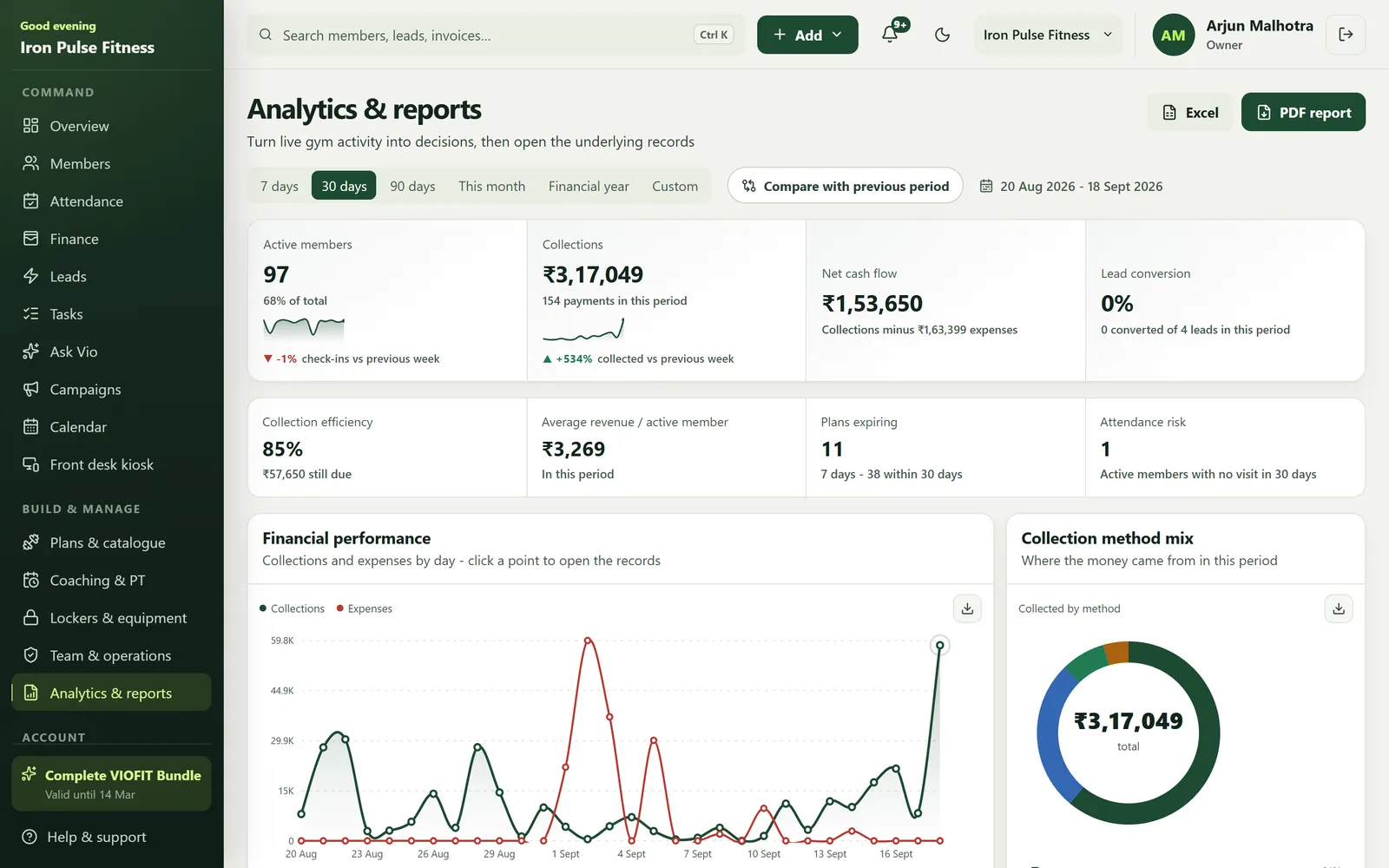
Run one weekly risk review
Choose one fixed day, such as Monday after the morning rush, and spend twenty minutes on a risk list. Include members who have not checked in for seven to ten days, whose plans end in the next 30 days, and whose PT or other services are nearly finished.
Give every name on the list an owner: the trainer who knows them, or one front-desk person. A list that belongs to everybody is followed up by nobody.
- One day, one list, one owner per member
- Note the reason when the member gives one
- Carry unresolved names to next week's list
- Remove members once their routine is back
Fix the first 30 days
The first month decides whether a gym becomes a habit. Many members who leave at the first renewal never built a routine in their first four weeks.
Make the first visits feel guided. Introduce the member to a trainer by name, give them a simple plan they can follow without help, and check in with them after their third and tenth day.
Watch the second visit closely. A new member who does not come back within the first week needs a friendly call, not a reminder at the end of the month.
- Introduce a named trainer or staff contact on day one
- Give a short, clear workout and diet plan
- Contact the member after the third and tenth day
- Ask what time of day suits them and suggest the right batch
Follow up like a coach, not a collector
A short WhatsApp message or call should open a conversation. Acknowledge the gap, ask whether anything is blocking the routine, and offer one simple next step.
For example: "Hi Rahul, we have not seen you at the gym since last Monday. Is everything okay? If your work timing has changed, we can move you to the evening batch. Team [your gym name]." It is personal, short and offers help instead of pressure.
Do not shame the member, comment on their weight in a message they did not ask for, or send the same automated script again and again. One respectful message and one follow-up are enough.
- Offer a short trainer check-in
- Help change the preferred time or batch
- Simplify the first workout back
- Clear up an app, gym pass or payment issue
Give the return visit a clear shape
Members are more likely to return when the next visit feels manageable. Agree a specific day and time, plan a short session, tell the front desk what was agreed, and follow up after the visit.
Record the reason and the action on the member's profile so another team member does not restart the same conversation from zero next week.
Make progress visible
Members stay when they can see momentum. Record weight and body measurements only when they are useful, pair them with attendance consistency, and discuss the trend without making medical claims.
Consistency is the progress most members can control. Ten visits this month compared with six last month is worth celebrating, even before the scale moves.
- Celebrate consistency, not only weight loss
- Set the next measurable checkpoint
- Keep workout and diet instructions easy to follow
- Review progress together every four weeks
Start renewal conversations 15 days early
A renewal conversation that starts on the expiry date feels like a bill. One that starts about 15 days earlier feels like planning the next phase of the member's training.
Use that conversation to review what went well, agree the next goal and recommend the plan that fits it. Then send one clear reminder with the plan, the amount and how to pay, and one more close to the date if needed.
- 15 days before expiry: review progress and the next goal
- 7 days before: one clear reminder with plan and amount
- On the expiry date: a short, friendly confirmation
- After expiry: one supportive message, then stop
A 90-day retention rhythm
Month one fixes onboarding: every new member gets a named contact, a simple plan and two early check-ins. Month two builds accountability: the weekly risk review becomes routine and every follow-up is recorded. Month three standardises renewals: conversations start 15 days early and reminders follow one agreed script.
At the end of the 90 days, compare your monthly renewal rate with the months before you started. Keep the habits that moved it and drop the ones that did not.
Track recovery, not only renewals
Renewal is the final result, but it arrives late. Attendance recovery is the earlier measure your team can improve every week: how many contacted members replied, came back within seven days and rebuilt a regular pattern.
VIOFIT keeps attendance, member notes, membership expiry, dues and WhatsApp follow-ups on the same member record, so the team can see who is drifting and act before the member disappears from view. Every gym can try it free for 15 days.
- Contacted
- Replied
- Return visit planned
- Returned
- Routine restored
- Renewed
Frequently asked questions
How do I find gym members who are about to quit?
Watch attendance, not only expiry dates. A member whose visits fall well below their own normal pattern, or a new member who never makes a second visit, is far less likely to renew. Review those members every week and contact them while they can still be helped back.
How soon should a gym follow up on low attendance?
Within one to two weeks of the drop. The longer a member stays away, the more settled their new routine becomes and the harder the return visit is.
What actually reduces gym member churn?
A strong first month, a named trainer or staff contact, early follow-up when attendance falls, visible progress and renewal conversations that start before the plan expires rather than after.
What is a normal churn rate for an Indian gym?
There is no reliable public benchmark for Indian gyms, so measure your own. Each month, count the members whose plans ended and how many of them renewed. Track that renewal rate month by month and compare it after each change you make.
Should I offer a discount to stop a member from leaving?
Use discounts last. Most members who drift away have a timing, confidence or routine problem, and a discount does not fix it. Solve the reason first; a renewal offer works better once the member is attending again.


